
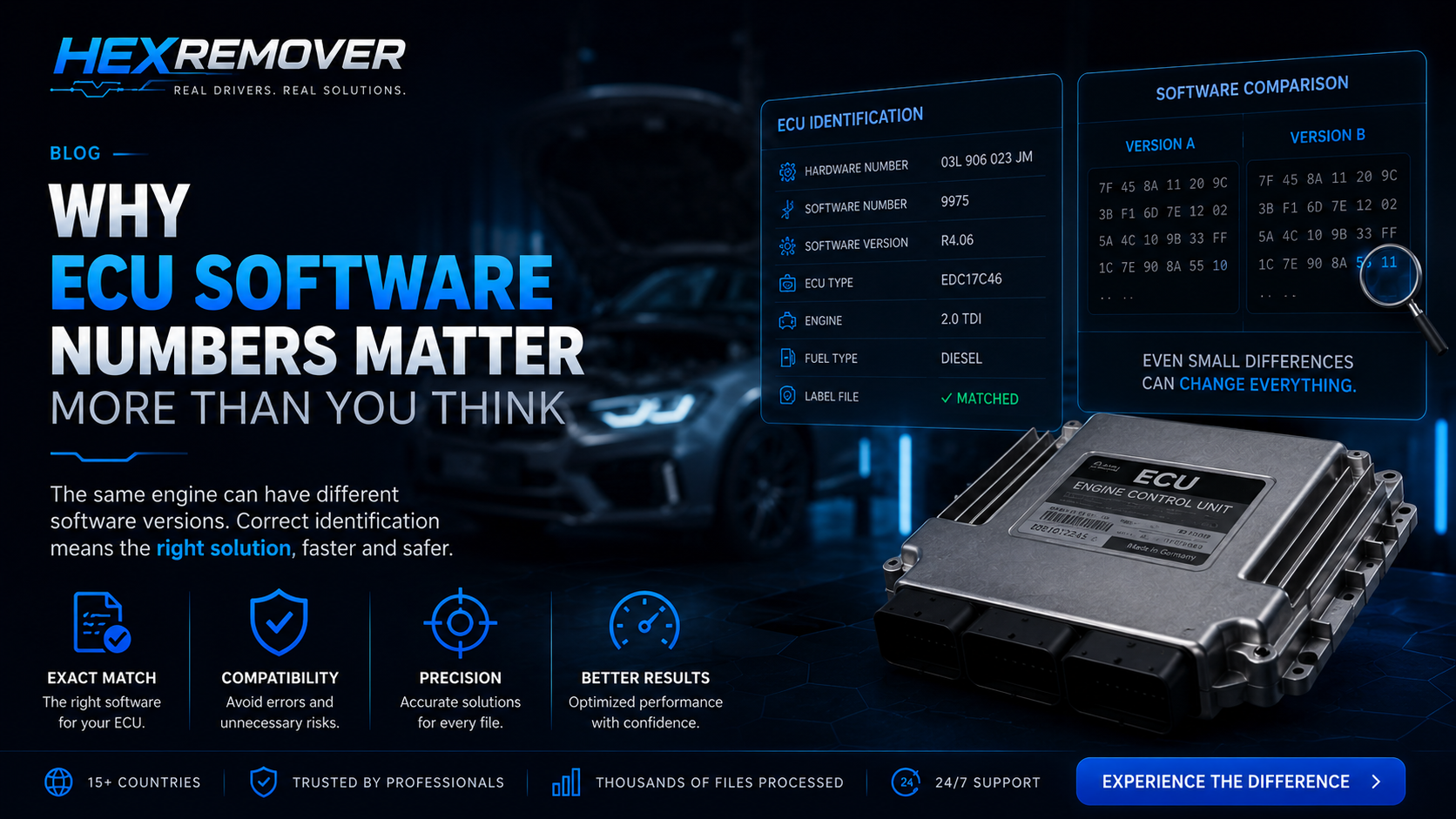
A common mistake in ECU tuning is identifying a vehicle only by its make, model and engine.
That information is useful, but it is not always enough.
The same engine can be installed in different vehicles, markets and production periods, while the ECU
software can change between versions.
This is why ECU software numbers matter.
Same Engine Does Not Always Mean Same Software
Imagine two vehicles equipped with the same engine.
Both may have the same displacement, power rating and ECU family. However, one may use a different
software version because of:
Production date
Emissions requirements
Transmission configuration
Market specification
Hardware revision
Manufacturer software updates
Different vehicle options
The calibration structure can therefore be different even when the engine itself is identical.
Hardware Number and Software Number
ECU identification normally contains several important references.
The hardware number describes the physical ECU configuration.
The software number identifies the software version programmed into that ECU.
Both can be useful when determining compatibility.
A file solution selected only by vehicle model can therefore be less reliable than one matched against
the actual ECU identification and original read.
Why File Matching Matters
A tuning file is not simply a universal package for an engine.
Calibration values are positioned within a specific software structure. If the wrong software version is
used, addresses and calibration areas may not correspond.
That can result in:
Incorrect calibration
Unexpected vehicle behavior
Flashing problems
Diagnostic errors
Compatibility issues
The safest workflow is to work from the actual original ECU file whenever possible.
Software Updates Can Change Things
Dealership software updates can also change the ECU software version.
A vehicle that originally left the factory with one software version may later receive another.
From the outside, nothing may appear different.
The engine is still the same.
The vehicle is still the same.
But the ECU software may no longer be identical.
This is another reason why experienced file technicians request the original read rather than relying
only on vehicle specifications.
What Information Should You Provide?
When submitting an ECU file, useful information includes:
Vehicle
Make
Model
Year
Engine
Fuel type
ECU
ECU manufacturer
ECU type
Hardware number
Software number
File
Original read
File extension
Reading tool
Reading method
Request
Stage 1
Vmax
ECO calibration
TCU calibration
DTC solution
Airbag and Other supported service
Providing this information reduces uncertainty before the file is processed.
Think of the Software Number as the ECU's Fingerprint
The vehicle tells you what the car is.
The ECU identification tells you what software environment you are actually working with.
That distinction is extremely important in professional file services.
At HexRemover, the goal is not simply to find something that looks similar. The objective is to work with
the actual software supplied and create a solution appropriate for that file.
Correct identification is the first step toward correct calibration.