
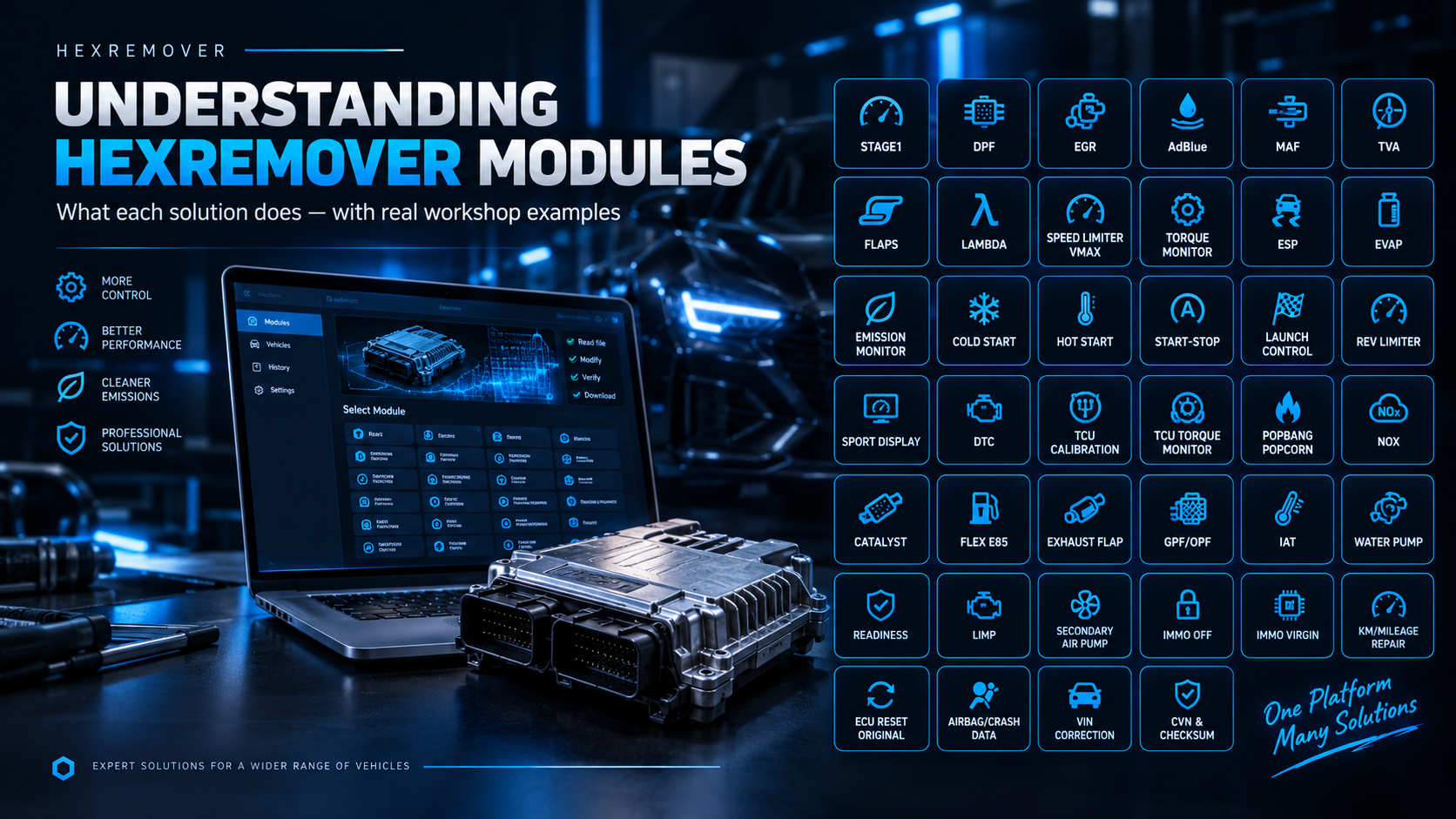
When you work with ECU files, one of the most common mistakes is assuming that the name of a
module tells you everything you need to know.
DPF, EGR, AdBlue, Lambda, MAF, DTC, Torque Monitor, VMAX, TCU, IMMO...
There are many different terms, and at first glance they can look like completely separate functions.
In reality, modern engine management systems are much more connected than that.
A problem that looks like an EGR issue can sometimes involve airflow readings. A torque limitation can
affect a Stage 1 calibration. A DPF-related fault may be caused by a sensor rather than the filter itself.
That is why choosing the correct module is just as important as modifying the file itself.
In this guide, we want to explain the main HexRemover modules in a straightforward way — what they
mean, what they are used for, and where you are most likely to encounter them on diesel and petrol
vehicles.
Important: Emission-related software modifications may be subject to different laws and
regulations depending on the country and intended use of the vehicle. Always check the
applicable local regulations before modifying DPF, EGR, AdBlue, NOx, Catalyst or GPF/
OPF-related systems.
Petrol or Diesel? Start Here.
Before choosing an ECU module, it helps to understand the type of engine you are working with.
Diesel engines
Diesel vehicles commonly involve systems such as:
DPF
EGR
AdBlue / SCR
NOx
MAF
FLAPS
TVA
VMAX
TORQUE MONITOR
IAT
READINES
LIMP MODE
HOT START
START STOP
For example, in a modern diesel engine, DPF regeneration, EGR operation, airflow measurement and
torque management can all interact with each other.
Petrol engines
Petrol vehicles commonly involve:
LAMBDA
CATALYST - DECAT
GPF / OPF
EVAP
SECONDARY AIR
MAF
TVA
IAT
FLEX E85
LAUNCH CONTROL
POPBANG / POPCORN / REV LIMITER
START-STOP
SPORT DISPLAY
But there is an important detail
A module is not always exclusive to petrol or diesel engines.
MAF, DTC, Torque Monitor, VMAX and Start-Stop, for example, can exist across different types of
vehicles.
The actual function depends on the vehicle, ECU, hardware and software version.
1. STAGE 1 – Engine Performance Calibration
Stage 1 is probably the best-known ECU tuning solution.
But a proper Stage 1 calibration is not simply about increasing fuel or turbo pressure.
Modern ECUs use complex torque-based control systems. Driver demand, requested torque, boost, fuel
quantity, ignition, air mass, torque limits and protection strategies can all be connected.
On diesel engines
Imagine a 1.6 or 2.0 turbo-diesel engine.
The factory calibration is designed around a specific power and torque target.
A Stage 1 calibration can adjust the appropriate control strategies to achieve increased performance
while taking the engine's operating limits into account.
On petrol engines
Turbocharged petrol engines work slightly differently.
Boost targets, ignition timing, fuel targets, torque models and temperature protection strategies may
all need to be considered together.
That is why a good Stage 1 file is not simply:
“Increase a few values and save the file.”
A proper calibration considers how the ECU's different control strategies interact.
2. DPF – Diesel Particulate Filter
DPF stands for Diesel Particulate Filter.
It is designed to capture soot particles produced by diesel combustion.
Modern diesel vehicles periodically perform regeneration to reduce the accumulated soot inside the
filter.
For example, a vehicle that is used mainly for short urban trips may struggle to complete regeneration
under suitable conditions.
Over time, this can lead to:
increased soot load,
high exhaust back pressure,
warning lights,
reduced performance,
DPF-related fault codes.
What does the DPF module do?
The DPF module is used to work with the relevant DPF control strategies in supported ECUs and
software versions.
It is primarily associated with diesel vehicles.
Petrol vehicles use a different type of particulate filter, generally referred to as GPF or OPF.
3. EGR – Exhaust Gas Recirculation
EGR stands for Exhaust Gas Recirculation.
The system redirects a controlled amount of exhaust gas back into the intake system.
One of its main purposes is to help control combustion temperatures and reduce NOx formation.
Over time, EGR systems can become affected by carbon deposits and mechanical problems.
For example, if an EGR valve cannot reach the requested position, the ECU may detect an airflow value
that does not match its expected model.
This can lead to:
EGR-related faults,
airflow-related faults,
poor drivability,
reduced performance.
Diesel
EGR is extremely common on diesel engines.
Petrol
Some petrol engines also use exhaust-gas recirculation strategies, but the system design can be quite
different.
That is why an EGR-related fault should not automatically be interpreted as a software problem.
4. AdBlue / SCR
AdBlue is used together with an SCR (Selective Catalytic Reduction) system on many modern diesel
vehicles.
The SCR system is designed to reduce NOx emissions.
Depending on the vehicle, the system can include:
AdBlue pump,
injector,
temperature sensors,
level sensors,
NOx sensors,
ECU control strategies.
For example, a commercial diesel vehicle can develop an AdBlue-related sensor or dosing problem.
Depending on the manufacturer, the ECU may then introduce additional operating or restart
restrictions.
The AdBlue module deals with relevant SCR/AdBlue control strategies on supported ECUs.
This is primarily a diesel-related system.
5. FULL EMISSION (DPF + EGR + ABDLUE) or (DPF + EGR + ADBLUE, NOX)
Full Emission can be thought of as a combined solution for several emission-related systems.
Depending on ECU support, this may involve systems such as:
DPF,
EGR,
AdBlue,
NOx,
other emission monitoring functions.
This can be useful when several related systems need to be addressed within the same ECU file.
However, Full Emission should not be considered a universal solution for every diesel vehicle.
The actual supported functions depend on the ECU and software version.
Additionally, when submitting files via our site, you can choose the "Full Emission" option, which offers more favorable pricing. When you select "Full Emission," there is no need to separately select the DPF, EGR, and AdBlue modules, as "Full Emission" covers them all.
6. MAF – Mass Air Flow
MAF stands for Mass Air Flow.
The MAF sensor measures the amount of air entering the engine and provides that information to the
ECU.
This measurement can be particularly important on diesel engines because airflow calculations are
closely related to EGR and fueling strategies.
For example, if the ECU expects a certain amount of air but receives an unexpected MAF reading, it may
identify a problem.
Diesel
MAF-related calibration work is common on diesel ECUs.
Petrol
MAF sensors are also used on many petrol engines.
However, some modern petrol engines rely on different load calculation strategies involving MAP,
throttle position and other sensors.
7. TVA – Throttle Valve Actuator
TVA generally refers to the Throttle Valve Actuator and its associated control strategies.
On petrol engines, the throttle is one of the main components used to control engine load.
On diesel engines, the throttle valve can have a different purpose.
It may be involved in:
EGR control,
airflow management,
engine shutdown behavior,
intake pressure management.
So the same TVA label can represent different functions depending on the engine and ECU.
8. FLAPS
FLAPS commonly refers to intake air control flaps, including systems such as swirl flaps.
These systems are particularly common on modern diesel engines.
The position of the intake flaps can be changed depending on engine speed and operating conditions
to influence airflow characteristics.
A mechanical flap problem, however, is still a mechanical problem.
Software cannot physically repair a broken actuator, damaged linkage or heavily damaged intake
component.
This distinction is important when diagnosing a vehicle.
9. LAMBDA
A Lambda sensor measures oxygen content in the exhaust gas.
This information helps the ECU understand combustion and, on many petrol engines, control the airfuel mixture.
Petrol engines
Lambda control can be closely related to:
fuel mixture,
closed-loop operation,
catalyst monitoring,
emission control.
Diesel engines
Modern diesel vehicles can also use Lambda/O2 sensors for different control and emission strategies.
Therefore, Lambda should not automatically be considered a petrol-only function.
10. CATALYST – DECAT Catalytic Converter
The catalytic converter is an important component of the vehicle's exhaust emission system.
On petrol engines, the three-way catalytic converter is especially important.
The ECU can use information from oxygen sensors to monitor catalyst operation and efficiency.
For example, if a catalyst is physically damaged or blocked, changing software does not physically
repair the catalyst.
That is why proper diagnosis should always come before a software solution.
We recommend using it in conjunction with the Lambda Module.
11. GPF / OPF
GPF and OPF refer to particulate filters used on modern petrol engines.
They perform a role similar in concept to a DPF, but the systems are not identical.
They are particularly common on modern direct-injection petrol engines.
A simple way to remember the difference is:
DPF = Diesel Particulate Filter
GPF / OPF = Gasoline / Otto Particulate Filter
The control strategies and regeneration behavior can differ significantly between them.
12. NOx
NOx refers to nitrogen oxides.
NOx control is a major part of modern emission management, particularly on diesel vehicles.
NOx control can involve several systems working together:
EGR,
SCR / AdBlue,
NOx sensors,
ECU calculations.
If a vehicle reports a NOx-related fault, the sensor itself is not necessarily the only possible cause.
Wiring, dosing systems, exhaust components and ECU calculations can also be involved.
13. EVAP
EVAP stands for Evaporative Emission Control System.
It is mainly associated with petrol vehicles.
Fuel naturally produces vapors inside the fuel tank. The EVAP system stores these vapors and later
routes them into the engine so they can be burned instead of being released directly into the
atmosphere.
A faulty purge valve, leak or related sensor can trigger EVAP fault codes.
This module is therefore much more commonly encountered on petrol vehicles.
14. FLEX E85
Flex E85 relates to engine calibration for fuels containing a high percentage of ethanol.
E85 can contain approximately 85% ethanol, although the exact fuel composition can vary.
Because ethanol behaves differently from conventional gasoline, the ECU may need different strategies
for:
fuel quantity,
ignition,
lambda targets,
cold starting,
load calculation.
Flex-fuel calibration is therefore much more than simply changing a fuel type setting.
15. EXHAUST FLAP
An exhaust flap controls exhaust gas flow under certain operating conditions.
Depending on the vehicle, it can be related to:
exhaust sound,
exhaust flow,
thermal management,
emission strategies.
The exact purpose varies between manufacturers and models.
This is why identifying the ECU and software version is important before selecting an Exhaust Flap
solution.
16. VMAX / SPEED LIMITER
VMAX or Speed Limiter refers to the ECU's vehicle speed limitation strategy.
For example, some commercial vehicles may leave the factory with a programmed maximum speed.
A VMAX modification changes the relevant speed limitation strategy where supported.
It is important to understand that:
Changing VMAX does not increase engine power.
It changes the speed limitation strategy.
17. TORQUE MONITOR
Modern ECUs rely heavily on torque-based engine management.
The ECU calculates requested and estimated engine torque and uses that information to control many
other systems.
This becomes particularly important during performance tuning.
For example, if a Stage 1 calibration increases the requested engine torque but another torque limiter
still expects the original factory value, the ECU may intervene and reduce the available torque.
Torque Monitor solutions are therefore closely related to advanced ECU calibration.
18. READINESS
Readiness refers to the status of certain OBD/emission monitoring tests.
An ECU can monitor different systems and run specific diagnostic routines.
Readiness tells us whether particular monitors have completed their required checks.
This is not exactly the same thing as a DTC.
A vehicle can have no visible fault code while certain readiness monitors have not completed.
19. START-STOP
Start-Stop automatically switches the engine off when the vehicle is stationary and restarts it when
driving conditions require.
For example, the engine may stop at a traffic light and restart when the driver releases the brake or
operates the clutch.
Start-Stop calibration deals with the relevant control strategies used by the ECU.
20. LAUNCH CONTROL
Launch Control is mainly associated with performance-oriented vehicles.
Its purpose is to control the engine and drivetrain during a standing launch.
Instead of simply allowing the engine to rev freely, the ECU can manage engine speed and torque
during the launch process.
Launch Control itself does not create additional horsepower.
It is a launch management strategy.
21. REV LIMITER
The Rev Limiter defines how the ECU limits maximum engine speed.
Depending on the ECU, this may involve:
fuel control,
ignition control,
throttle intervention,
torque reduction.
Changing the rev limit should always take the mechanical limitations of the engine into consideration.
The ECU may be capable of allowing a certain RPM, but that does not automatically mean the engine is
mechanically designed to operate safely at that RPM.
Our REV LIMIT Burbles Module is also available.
We developed this module—much like a Popbang/Popcorn module—specifically for tuning enthusiasts.
22. HARDCUT
Hardcut refers to a more aggressive style of RPM limitation.
It is commonly associated with performance-oriented tuning.
However, aggressive RPM limiting can place additional stress on the engine, turbocharger, exhaust
system and drivetrain.
It should therefore be considered a calibration choice rather than a harmless sound modification.
23. POPBANG / POPCORN
PopBang or Popcorn refers to calibration strategies intended to create an audible popping or crackling
exhaust character, particularly on petrol performance vehicles.
The effect is generally associated with how fuel and ignition are controlled during overrun or throttle lift
conditions.
Aggressive settings can increase exhaust temperatures and place additional stress on components such
as:
catalytic converters,
turbochargers,
exhaust valves,
exhaust systems.
The mechanical condition of the vehicle should therefore always be considered.
24. COLD START
Cold Start refers to the ECU's strategy when starting a cold engine.
When engine temperature is low, the ECU may use different:
fuel targets,
ignition strategies,
airflow settings,
emission control strategies.
On many petrol engines, cold-start calibration is also closely related to getting the catalytic converter up
to operating temperature quickly.
25. HOT START
Hot Start refers to the engine's starting strategy when the engine is already at operating temperature.
This can become relevant when a vehicle experiences difficult hot starting.
For example, a diesel engine that cranks for a long time before starting when hot may have issuesinvolving:
battery condition,
starter speed,
fuel pressure,
injectors,
crankshaft position sensing.
Software should not automatically be assumed to be the root cause.
26. IAT – Intake Air Temperature
IAT stands for Intake Air Temperature.
The ECU uses intake temperature information in several engine control calculations.
This can be particularly important on turbocharged engines.
As intake temperature increases, the ECU may alter:
ignition,
fueling,
boost control,
engine protection strategies.
An IAT-related software solution should therefore be considered only after determining whether the
actual sensor or system is functioning correctly.
27. WATER PUMP
Modern vehicles increasingly use electronically controlled or electric water pumps.
The ECU can manage cooling based on:
engine temperature,
engine load,
driving conditions,
thermal management requirements.
Water Pump solutions relate to the relevant control strategies on supported ECUs.
Again, software cannot repair a physically failed pump.
28. SECONDARY AIR PUMP
Secondary Air Injection is mainly associated with petrol engines.
During cold starting, additional air can be introduced into the exhaust system to help emission
components reach operating temperature more quickly.
A failure in the pump, valve or related control system can trigger diagnostic faults.
29. ESP
ESP stands for Electronic Stability Program.
Modern vehicles allow the engine ECU and stability control systems to communicate with each other.
For example, if the stability system detects wheel slip, it can request a reduction in engine torque.
This is why engine torque management cannot always be considered independently from the rest of
the vehicle.
30. SPORT DISPLAY
Some vehicles provide performance information through a Sport Display.
Depending on the manufacturer, the display may show:
torque,
power,
boost pressure,
temperatures,
G-force,
other performance parameters.
The displayed values are calculated by the vehicle's software and should not automatically be
considered equivalent to an independent dyno measurement.
31. AGS
AGS can refer to different automated gearbox control systems depending on the manufacturer and
ECU.
For that reason, the module name alone is not enough to determine what should be changed.
The vehicle, gearbox type, TCU and software version should be identified first.
32. TCU CALIBRATION
TCU stands for Transmission Control Unit.
While the ECU manages the engine, the TCU manages the transmission.
Depending on the gearbox, TCU calibration can involve strategies related to:
gear shifting,
torque requests,
shift behavior,
clutch control,
transmission limits.
This becomes particularly important on tuned vehicles.
If the engine produces substantially more torque than the original calibration expects, the transmission
software may also need to be considered.
33. TCU TORQUE MONITOR
Torque management does not stop at the engine ECU.
The transmission can also monitor engine torque.
For example, if the engine produces more torque after tuning but the TCU still expects the original
torque model, the gearbox may intervene.
TCU Torque Monitor solutions address relevant torque monitoring strategies on supported
transmission systems.
34. IMMO OFF (FLASH, EPROM, TCM)
IMMO stands for Immobilizer.
The immobilizer is a vehicle security system designed to prevent unauthorized engine starting.
IMMO OFF refers to changing the relevant immobilizer-related software behavior in supported ECUs.
It can be encountered in professional ECU replacement, testing and certain repair scenarios.
Because immobilizer systems are security-related, correct vehicle identification and applicable legal/
service procedures are essential.
35. IMMO VIRGIN
“Virgin” is a term commonly used when preparing an ECU for a new pairing or programming procedure.
For example, a replacement ECU may contain information associated with the vehicle from which it was
originally removed.
A virginization procedure can prepare the unit for another legitimate pairing procedure where
supported.
It is important to understand:
IMMO OFF and IMMO VIRGIN are not the same operation.
They serve different purposes.
36. ECU RESET ORIGINAL
Sometimes an ECU needs to be returned to its original software configuration.
This can happen after previous tuning work, testing or calibration changes.
An Original Reset solution is used on supported ECUs to return the relevant software area to its original
state.
The most important point here is using the correct original file for the exact ECU and software version.
37. LIMP MODE
Limp Mode is a protection strategy used by an ECU when it detects conditions that may require reduced
engine performance.
Possible triggers can include:
incorrect boost pressure,
fuel pressure problems,
sensor inconsistencies,
torque model conflicts,
critical system faults.
This is why Limp Mode is often not the actual problem.
It can simply be the ECU's response to another problem.
38. OIL PRESSURE FIX
Modern engines can monitor oil pressure electronically.
The ECU may use oil pressure information as part of its protection and engine management strategies.
Oil Pressure Fix solutions relate to supported ECU control strategies.
However, if the engine genuinely has low mechanical oil pressure, software should never be considered
a substitute for mechanical diagnosis and repair.
39. ACT
ACT is an abbreviation that can refer to different functions depending on the vehicle manufacturer and
ECU.
Therefore, the module name alone should not be used to assume that the same modification applies to
every vehicle.
Vehicle identification and ECU software support remain essential.
40. DTC vs Readiness vs Emission Monitor
These three terms are frequently confused.
DTC
A diagnostic fault code generated by the ECU.
Readiness
The completion status of certain diagnostic monitors.
Emission Monitor
The ECU strategies used to monitor emission-related systems.
They are related, but they are not the same thing.
A vehicle can have no active DTC while certain diagnostic monitors are still incomplete.
41. KM / MILEAGE REPAIR
Mileage information can be stored in more than one vehicle module.
Depending on the manufacturer, mileage-related information may exist in:
instrument cluster,
ECU,
BCM/BSI,
TCU,
other control modules.
That is why mileage-related work requires an understanding of where the relevant information is
stored.
Mileage Repair solutions are intended for supported modules and legitimate professional service
scenarios.
42. VIN CORRECTION
VIN stands for Vehicle Identification Number.
It is normally a 17-character identification number assigned to the vehicle.
When an ECU or another control module is replaced, the stored VIN may not match the vehicle.
For example, a used replacement ECU may still contain the VIN of the vehicle it originally came from.
VIN Correction solutions can be used on supported systems to address these identification mismatches.
43. CVN
CVN generally stands for Calibration Verification Number.
It is associated with calibration verification and software integrity mechanisms used by certain ECUs
and diagnostic systems.
This is why checksum and calibration verification concepts become important when ECU software is
modified.
44. CHECKSUM
Checksum is one of the most important technical aspects of ECU file modification.
When data inside an ECU file is changed, some ECUs require the checksum to be recalculated.
If the checksum is incorrect, the ECU may reject the file or behave unexpectedly.
For this reason, professional ECU file processing involves more than simply changing calibration data.
The ECU's checksum structure must also be taken into account.
46. AIRBAG / CRASH DATA
Airbag control units can store crash-related information following an accident.
Crash Data solutions are designed for supported airbag modules and professional repair processes.
Airbag systems are safety-critical systems and should be treated differently from normal engine
calibration.
Correct module identification and appropriate repair procedures are essential.
Choosing the Right ECU Module
So, which module should you choose?
The simplest answer is:
Choose the module based on what the ECU actually needs — not simply on the symptom.
For example, a customer may say:
“The DPF warning light is on.”
That does not automatically mean the software needs a DPF solution.
A proper diagnosis may involve checking:
DTCs,
differential pressure,
temperature sensors,
regeneration history,
calculated soot load,
physical condition of the filter.
The same principle applies to performance tuning.
If a customer says:
“The car has Stage 1, but it doesn't make the expected power.”
The answer may not be another Stage 1 file.
The problem could involve:
torque limits,
boost control,
fuel delivery,
airflow,
torque monitoring,
protection strategies.
Understanding how the ECU works is what separates simple file editing from proper calibration work.
Why the Same Module Can Be Different on
Different ECUs
This is especially important for anyone working with online ECU file services.
Two vehicles may both use an ECU from the same general family, such as Bosch EDC17, while having
completely different:
hardware numbers,
software numbers,
calibration structures,
processors,
memory layouts,
torque models,
emission strategies.
Therefore:
“It's an EDC17, so the same solution should work.”
is not a reliable approach.
A much better workflow is:
Vehicle → ECU → Hardware → Software → Original File → Required Module
This is one of the most important principles in professional ECU file processing.
What Information Should You Provide When Ordering a File Service?
The more accurate the vehicle information, the easier it is to identify the correct solution.
Whenever possible, provide:
Vehicle make
Model
Engine
Fuel type
ECU type
Hardware number
Software number
Original ECU file
This information allows the available solutions to be matched more accurately to the actual ECU
software.
One Module Does Not Always Mean One Simple Change
This is perhaps the most important thing to understand.
Modern ECUs are not simple ON/OFF computers.
A single function can be controlled by several related strategies.
For example, a diesel engine may have a relationship between:
Turbo → Airflow → MAF → EGR → Fuel → DPF → NOx → AdBlue → Torque Management
A modern petrol engine may involve:
Throttle → Airflow → Fuel → Lambda → Ignition → Catalyst → GPF/OPF
Changing one part of this chain without understanding the others can produce unexpected results.
This is why professional ECU file work requires more than finding a pattern in a hex file.
Final Thoughts
There are a lot of terms in the ECU tuning world.
DPF, EGR, AdBlue, MAF, TVA, Lambda, NOx, GPF, OPF, VMAX, Torque Monitor, TCU, IMMO, DTC...
At first, they can seem complicated.
But once you understand what each system actually does, the picture becomes much clearer.
The most important lesson is simple:
The module name is only the beginning.
The real work starts with identifying the vehicle, ECU, hardware and software correctly, understanding
the function involved, and then selecting the appropriate solution.
At HexRemover, this is exactly why module support is organized around specific ECU and software
combinations rather than treating every vehicle as if it were the same.
Because professional ECU file service is not simply about changing a file.
It is about understanding what needs to be changed, why it needs to be changed, and which
solution is appropriate for that specific ECU.
Correct ECU.
Correct file.
Correct module.
Correct solution.
That is the foundation of professional ECU file processing.