
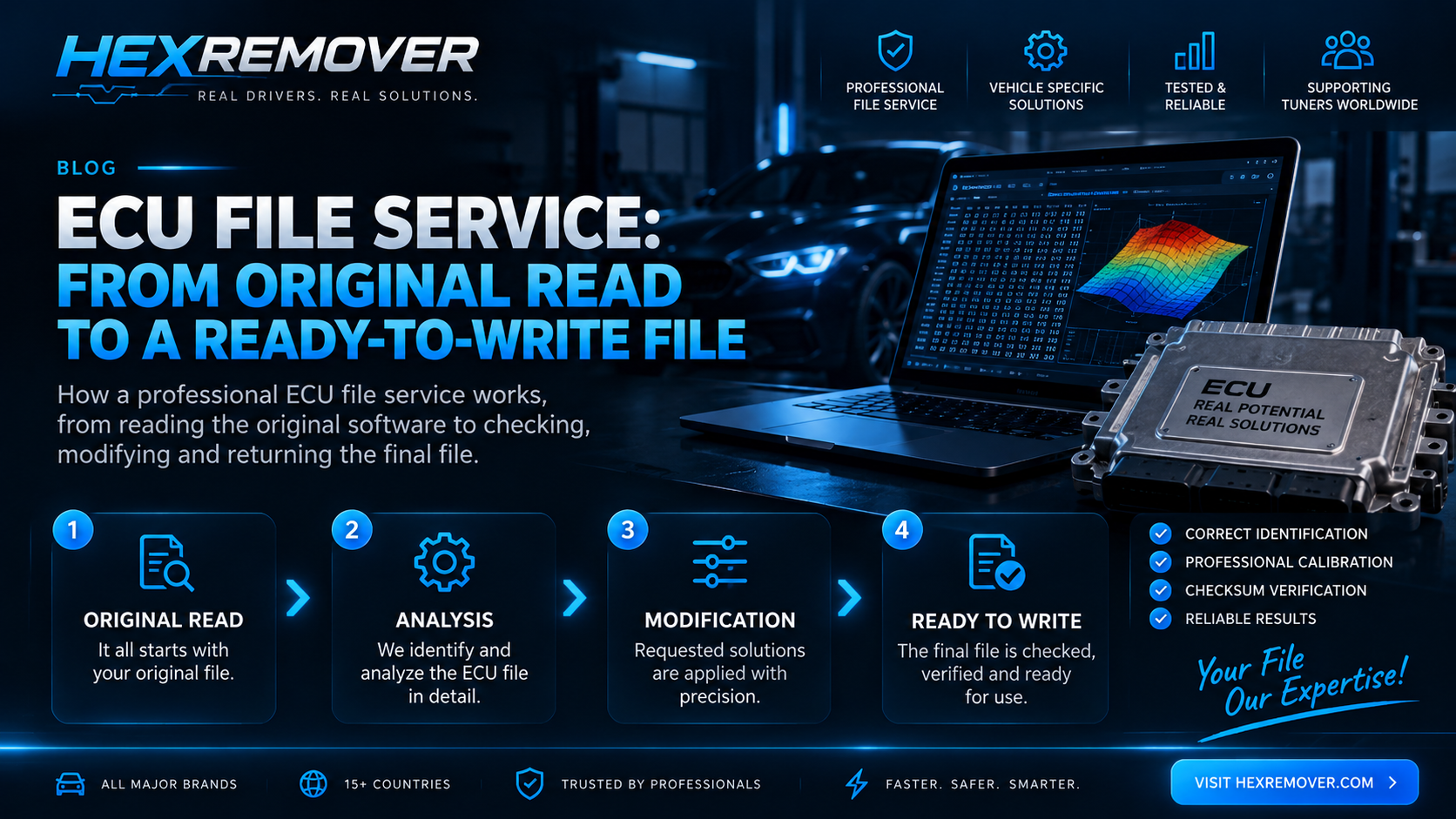
When people hear the term ECU file service, they often imagine a simple process: upload a file, wait a
few minutes, and download a modified version.
In reality, a professional ECU file service involves much more than changing a few values inside a binary
file.
The quality of the final result depends on the relationship between the vehicle, ECU hardware, software
version, original read method, requested modification and the calibration structure inside the file.
It Starts With the Original ECU File
The original read is the foundation of the entire process.
A file may belong to the correct vehicle model and engine while still being unsuitable for another ECU
software version. Two vehicles with the same engine can have different software versions, different
hardware revisions or different calibration strategies.
That is why the original ECU read should be treated as the primary reference.
Before any modification is made, the file should be evaluated together with information such as:
Vehicle make and model
Model year
Engine
ECU manufacturer and type
Hardware number
Software number
Reading tool
Reading method
Requested service
Existing fault codes or modifications
The more complete the information, the lower the risk of selecting an incompatible solution.
Analysis Comes Before Modification
A professional file service should not begin by immediately changing values.
First, the file needs to be identified.
The ECU family and software structure provide important information about where calibration data,
limiters, diagnostic strategies and other relevant sections are located.
This is particularly important on modern ECUs where a simple visual comparison of hexadecimal data is
not enough to understand the complete calibration strategy.
A file that looks similar to another file may still require a completely different modification.
Calibration Is Not the Same as Editing Random Values
ECU software contains many interconnected strategies.
For example, torque management can influence several other systems. Boost pressure, fuel quantity,
ignition or injection timing, thermal protection and torque monitoring may all interact with one another.
Changing one area without considering the related strategies can produce an inconsistent calibration.
Professional calibration therefore focuses on the relationship between maps and control strategies
rather than treating the file as a collection of isolated numbers.
Verification Is Part of the Job
A modified file should be checked before it is returned.
Depending on the ECU and requested service, verification can include:
File structure
Software compatibility
Modification consistency
Checksum requirements
Unexpected changes
Original-versus-modified comparison
The purpose is simple: the returned file should correspond to the exact request and the exact ECU
software provided by the customer.
Why the Original File Should Always Be Kept
Your original ECU read is your recovery baseline.
Even when everything works perfectly, keeping the original file is good practice.
It allows the vehicle to be returned to its previous software state when required and gives the
technician a reliable reference for future work.
This is one reason professional file management matters just as much as the calibration itself.
The HexRemover Approach
At HexRemover, the file is treated as a vehicle-specific software task rather than a generic file
replacement.
The objective is to work from the customer's original read, identify the software correctly, apply the
requested solution and return a file appropriate for the supplied ECU configuration.
A reliable ECU file service should make the process simple for the technician while keeping the technical
workflow precise behind the scenes.
The better the input, the better the calibration process.
If you have an original ECU or TCU file and know exactly what service you need, the first step is simple:
provide the correct file and the correct vehicle information.